
News
Texas Instruments On Its Path to 95% In-House Manufacturing by 2030
Texas Instruments (TI) is aggressively pursuing a strategy to increase its self-reliance in semiconductor production, aiming to grow its internal manufacturing capacity to over 95% by 2030. Stefan Bruder, President of TI EMEA and India, highlighted the company’s commitment to investing more than $60 billion in seven fabs across three U.S. mega-sites in Texas and Utah since 2021, including a significant $40 billion at its new 300mm site in Sherman, Texas. This initiative is designed to ensure geopolitically dependable capacity and supply chain resilience by enabling dual-flow capabilities across different global manufacturing locations. TI is also focusing on local raw material procurement to further enhance supply chain stability. The company’s AI strategy encompasses both power-efficient gallium nitride (GaN) products for data centers and embedded AI capabilities in edge devices, such as their C2000 microcontrollers for solar inverters, many of which are being developed in collaboration with its large R&D hub in India.

Launches
Broadcom Expands AI Ethernet Offerings with Tomahawk 6 CPO Switch and Thor Ultra NIC
Broadcom Inc. is significantly enhancing its AI networking portfolio with the launch of its Tomahawk 6 – Davisson (TH6-Davisson) Co-Packaged Optics (CPO) Ethernet switch and the Thor Ultra 800G AI Ethernet Network Interface Card (NIC). The TH6-Davisson, Broadcom’s third-generation CPO Ethernet switch, doubles the bandwidth of existing CPO switches, delivering 102.4 Terabits per second of optically enabled switching capacity while improving power efficiency and traffic stability critical for large-scale AI clusters. This advancement addresses the exploding demand for optical interconnects in AI networks, driven by GPUs requiring substantially more optical bandwidth than traditional CPUs. Concurrently, the Thor Ultra 800G AI Ethernet NIC, now sampling, is the industry’s first to support a single 800G flow and adopts the Ultra Ethernet Consortium (UEC) specification. This enables advanced RDMA capabilities, including packet-level multipathing, out-of-order packet delivery, selective retransmit, and scalable congestion control, providing an open and efficient solution for interconnecting hundreds of thousands of XPUs in AI workloads.

Charts
The AI PC: A New Category Poised to Reignite the PC Market
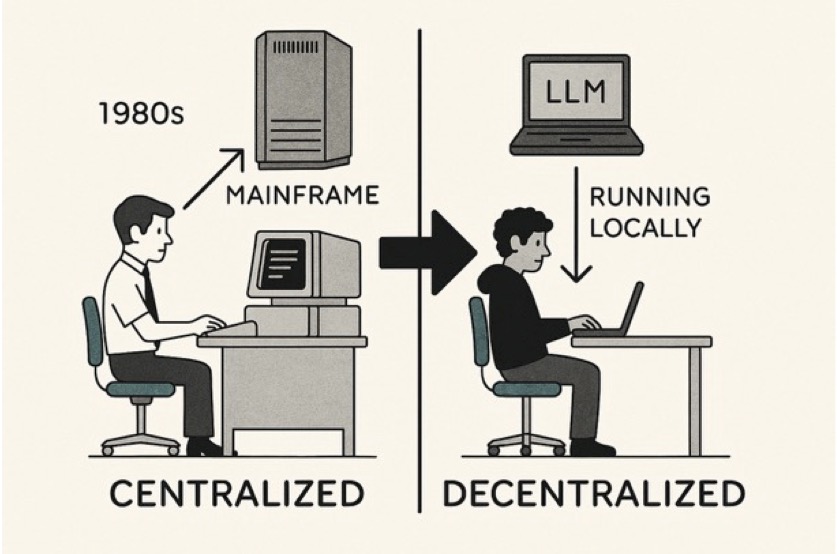
The personal computing industry is experiencing its most significant transformation since the 1980s with the emergence of the AI PC, a category poised to reignite growth in a previously plateaued market. Defined by the integration of a dedicated Neural Processing Unit (NPU) or equivalent accelerator, AI PCs enable on-device machine learning, running large language models, generative tools, and real-time personalization locally. Apple has established an early lead by incorporating its Neural Engine into all M-series Macs since 2020, achieving seamless vertical integration across silicon, OS, and frameworks. While Intel and AMD are rapidly catching up with their NPU-equipped platforms, only about 30% of x86 PCs shipped in 2025 qualify as AI PCs. Gartner projects a substantial market surge, with AI PC shipments expected to reach approximately 114 million units in 2025, a 165% increase over 2024, representing over 40% of the total PC market. This shift reflects both corporate demand for efficiency tools and individual users’ desire for local AI capabilities, promising to redefine productivity and creativity in the digital era.
Research
Team Develops High-Speed, Ultra-Low-Power Superconductive Neuron Device for Neuromorphic Computing
Researchers have developed a novel superconductive neuron device that promises to advance large-scale, high-speed, and ultra-low-power neuromorphic network circuits. Published in Neuromorphic Computing and Engineering, this groundbreaking device employs digital processing using superconducting circuits that utilize magnetic flux quanta as signal carriers. This approach significantly eliminates variations in the characteristics of elemental circuits, a common challenge in hardware implementation of neuromorphic systems. The team’s compact design implements the Rectified Linear Unit (ReLU) activation function through frequency conversion, leveraging single flux quantum logic. A key advantage is its remarkable robustness against device variability, maintaining ideal input-output characteristics even with up to 20% parameter variations. This marks a substantial improvement over conventional analog-based neuron devices, which are highly sensitive to non-uniformity and often suffer from high power consumption and limited capacity. This innovation paves the way for scalable superconducting neural networks, offering a path to ultra-high-speed and energy-efficient AI applications.

Insight
Synopsys Webinar: IP Design Considerations for Real-Time Edge AI Systems
A recent webinar presented by Synopsys, featuring Hezi Saar, Executive Director of Product Line Management for Mobile, Automotive, and Consumer IP, delved into the critical IP design considerations for real-time AI systems at the edge. Saar, drawing from over two decades of experience in the semiconductor industry, provided a comprehensive overview of how AI is driving semiconductor growth and the motivations behind shifting AI workloads from the cloud to edge devices. He highlighted that power efficiency is a crucial factor, with on-device (edge) AI demonstrating up to 200 times more efficiency compared to cloud-based solutions. The presentation explored the unique requirements for cost, performance, area, and power across a broad range of smart and connected edge devices. Saar also discussed the increasing quality of small models for edge AI, the role of AI companion chips, and the impact of multi-die approaches in addressing consumer demands for cost-effective products, emphasizing that this shift is driving the next innovation cycle in the industry.

Stay tuned for more essential insights and updates as the semiconductor industry continues to innovate and redefine the future of technology!