
News
L&T Semiconductor and Hon Young Partner on High-Voltage SiC Wafer Development
L&T Semiconductor Technologies (LTSCT) and Hon Young Semiconductor (HYS) have announced a long-term partnership to jointly develop high-voltage silicon carbide (SiC) wafers, ranging from 650V to 3300V. This collaboration aims to meet the escalating demand for SiC devices in critical sectors.
- The partnership targets automotive (EVs), renewable energy (solar inverters), and industrial applications.
- SiC wafers provide a base for high-voltage power devices like MOSFETs and SBDs, offering lower switching losses and improved thermal performance over traditional silicon.
- LTSCT, a fabless company, will leverage HYS’s SiC wafer fabrication expertise to ensure supply reliability, competitive pricing, and accelerate product development.

Launches
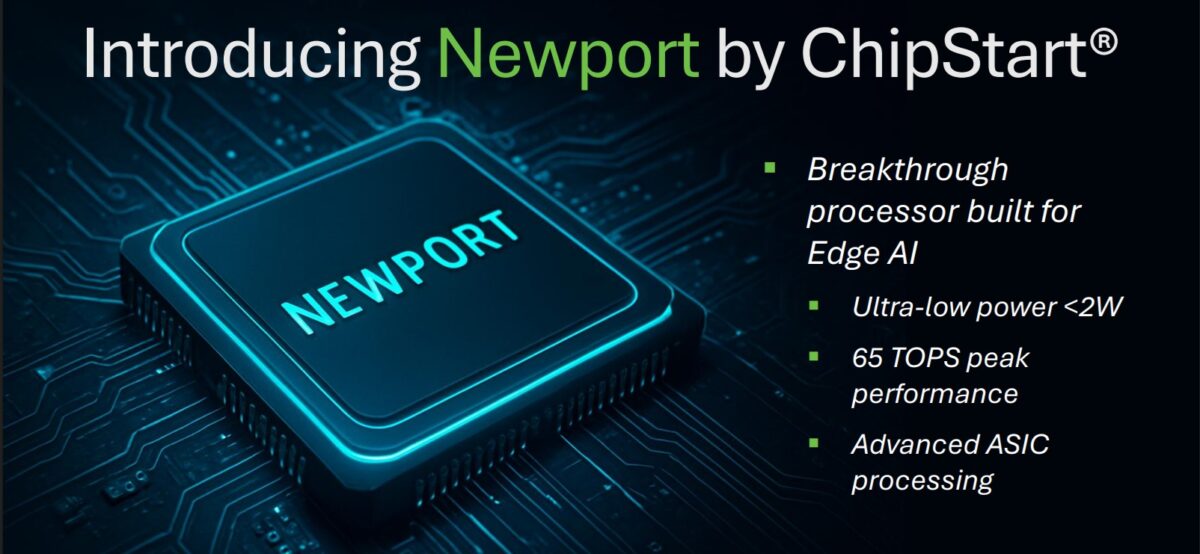
TekStart Unveils Newport, a High-Performance, Ultra-Low-Power Edge AI Processor
TekStart Group’s ChipStart division has launched Newport, a groundbreaking Edge AI processor designed to bring advanced AI inference directly to where data is generated, with remarkable power efficiency. Newport delivers 65 TOPS peak performance while consuming under 2 watts.
- The processor addresses critical Edge AI challenges by enabling ultra-low-power, on-device learning and real-time inference, significantly reducing dependency on cloud computing.
- Its versatile architecture allows seamless integration into diverse applications such as surveillance, agriculture, wearables, and industrial automation, supporting adaptive AI capabilities.
- Newport is poised to power the future of agentic AI systems—proactive, autonomous, targeted, and collaborative—without the energy overhead of traditional interconnects.
Charts
DeepOHeat-v1: Enhancing 3D-IC Thermal Simulation with Operator Learning
Researchers from Intel Corporation, University of California, Santa Barbara, and Cadence have published a new paper on DeepOHeat-v1, an enhanced physics-informed operator learning framework for fast and trustworthy thermal simulation and optimization in 3D-IC design.
- DeepOHeat-v1 achieves significant improvements:
- 1.25x and 6.29x reduction in error for multi-scale thermal patterns.
- 62x training speedup and 31x GPU memory reduction using a separable training method.
- 70.6x speedup for the entire thermal optimization process, effectively minimizing peak temperature through optimal placement of heat-generating components.
- The framework integrates Kolmogorov-Arnold Networks and provides a confidence score to evaluate result trustworthiness, ensuring high accuracy comparable to finite difference solvers.
Research
Unified Memristor-Ferroelectric Memory for Energy-Efficient AI Training
A research team from Université Grenoble Alpes, Université de Bordeaux, and Université Paris-Saclay has developed a novel memory device that unifies memristors and ferroelectric capacitors (FeCAPs) within a single stack. This hybrid approach promises significant advancements for energy-efficient training and implementation of AI systems.
- The memory combines the analog weight storage and energy efficiency during read operations of memristors, ideal for AI inference.
- By integrating FeCAPs, it also offers rapid and low-energy updates, which are crucial for training machine learning algorithms and continuous learning in AI systems.
- This breakthrough could enable more efficient edge AI, allowing AI algorithms to run directly on local hardware without heavy reliance on remote cloud servers.

Insight
The Growing Ecosystem Imperative for Physical AI (Robotics)
Industry experts, including Anders Billesø Beck from Universal Robots and Paul Williamson from Arm, emphasize the critical need for a robust technology ecosystem to realize the full potential of “physical AI” or embodied AI in robotics. They highlight challenges and opportunities in this nascent field.
- AI is essential for “human-scale automation,” augmenting or replacing humans in variable tasks like logistics and complex assembly, which traditional engineering struggles with.
- Functional safety for robotics is becoming increasingly complex with AI, requiring continuous innovation from silicon to ecosystem, with a focus on predictability and flexible safety capabilities.
- A strong software ecosystem with commonality and interoperability is vital, allowing startups to focus on software innovation while leveraging established hardware infrastructure and support.

Stay tuned for more cutting-edge developments shaping the future of semiconductors and intelligent systems.