News
NVIDIA, South Korea Government and Industrial Giants Build AI Infrastructure and Ecosystem to Fuel Korea Innovation, Industries and Jobs
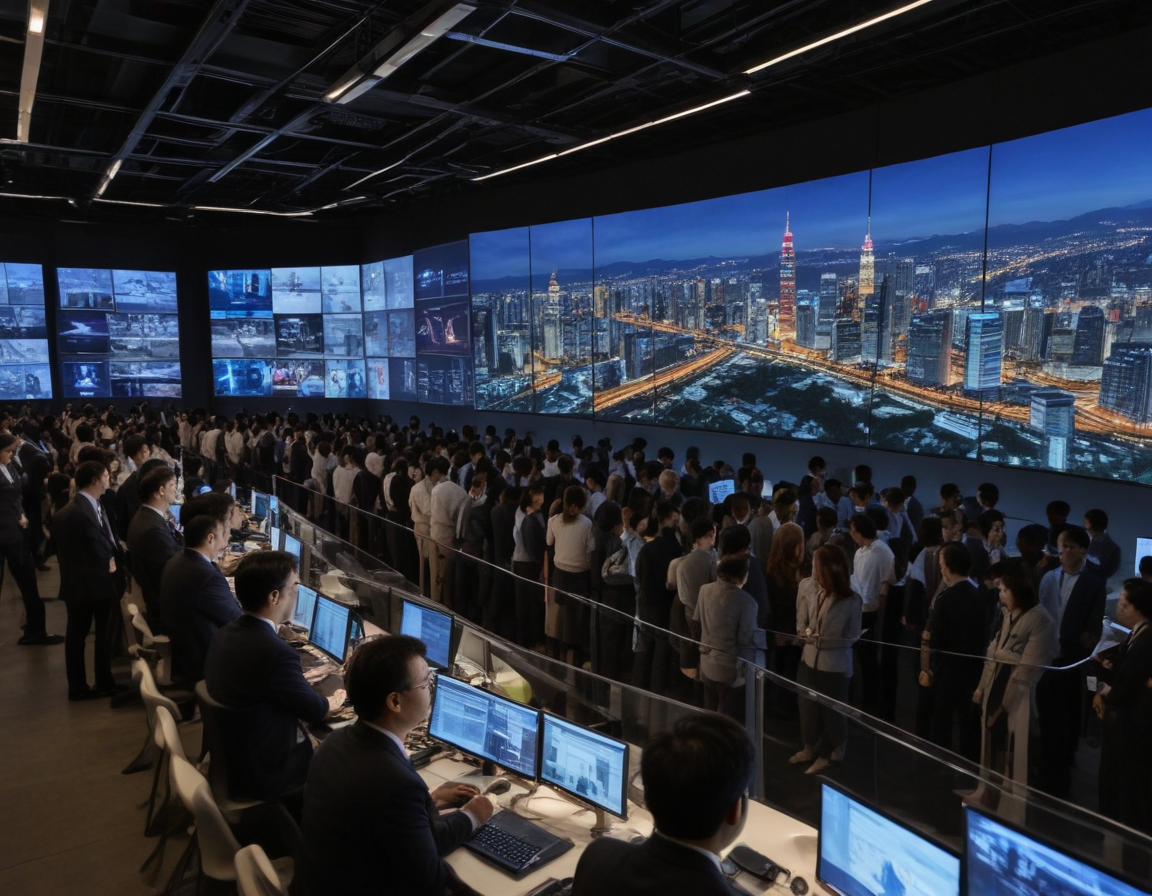
NVIDIA is partnering with South Korea to significantly expand the nation’s AI infrastructure, deploying over a quarter-million NVIDIA GPUs across sovereign clouds and AI factories. This initiative, announced during the APEC Summit, is set to fuel AI-enabled economic growth and innovation across key Korean industries, including automotive, manufacturing, and telecommunications.

- South Korea plans to deploy over 250,000 NVIDIA GPUs to accelerate sovereign AI development and bolster national AI capabilities.
- Industry leaders like Samsung, SK Group, and Hyundai Motor Group are making substantial investments to build NVIDIA AI factories for advanced manufacturing and physical AI development.
- Collaborations also extend to AI-RAN, 6G infrastructure, quantum computing research, and a new startup alliance to foster the nation’s AI ecosystem.
Launches
onsemi Unveils Vertical GaN Semiconductors: A Breakthrough for AI and Electrification
onsemi has introduced groundbreaking vertical gallium nitride (vGaN) power semiconductors, setting a new benchmark for power density, efficiency, and ruggedness in applications like AI data centers and electric vehicles. Developed and manufactured at onsemi’s Syracuse, NY, fab, this proprietary GaN-on-GaN technology enables current to flow vertically through the compound semiconductor, supporting higher operating voltages and faster switching frequencies.
- vGaN technology offers superior power density, efficiency, and ruggedness for demanding AI and electrification applications.
- The GaN-on-GaN design reduces energy loss by nearly 50% and allows for smaller, lighter systems by operating at higher frequencies.
- onsemi is currently sampling 700V and 1200V devices to early access customers, targeting AI data centers, EVs, and renewable energy.
Charts
U.S. Electronics Production Growing Amidst Global Shifts
U.S. electronics production has shown an accelerating growth trend over the past ten months, with the three-month average change versus a year ago (3/12 change) increasing from 0.4% in October 2024 to 6.2% in August 2025. This growth is partly attributed to companies shifting manufacturing to the U.S., influenced by tariff policies. Despite this, employment in the U.S. electronics manufacturing sector has seen a decline. Globally, China’s electronics production remains robust.
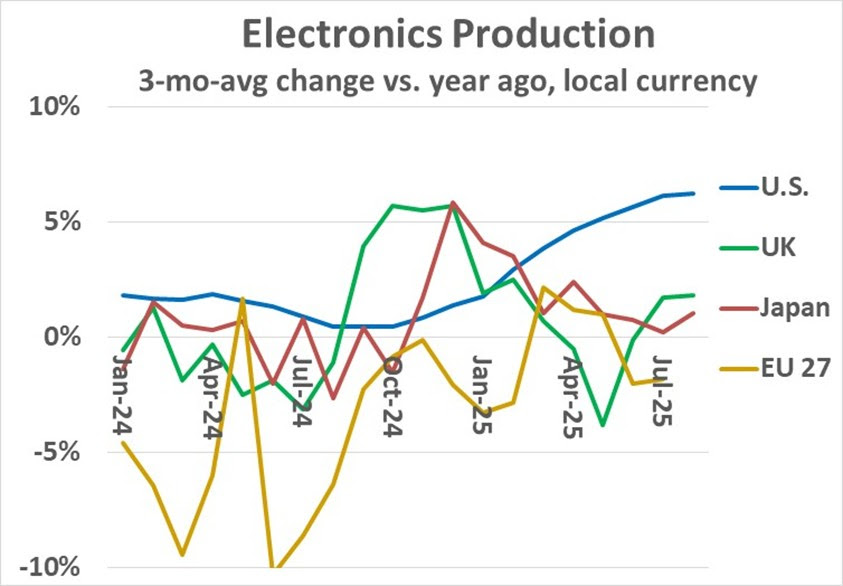
- U.S. electronics production significantly accelerated, with a 3/12 change rising to 6.2% by August 2025.
- Despite increased production, U.S. electronics manufacturing employment decreased from 1.04 million jobs in January 2024 to 1.001 million in August 2025.
- China’s electronics production maintained steady growth between 10% to 13%, indicating resilience despite global manufacturing shifts.
Research
imec Sets Electro-Optic Performance Record with Thin-Film Strontium Titanate at Cryogenic Temperatures
Imec researchers, in collaboration with KU Leuven and Ghent University, have engineered thin-film strontium titanate (SrTiO₃) to achieve a record electro-optic performance at 4 Kelvin (cryogenic temperatures). Published in Science, this breakthrough demonstrates an effective Pockels coefficient of nearly 350 pm/V with remarkably low optical loss, surpassing any other thin-film electro-optic material at this temperature.

- Imec achieved record electro-optic performance with thin-film SrTiO₃ at 4 Kelvin, critical for quantum devices.
- The material demonstrates a Pockels coefficient of nearly 350 pm/V, enabling efficient light modulation with minimal optical loss.
- This advance facilitates the development of smaller, faster electro-optic components for next-generation quantum interconnects, modulators, and transducers.
Insight
Even With AI Inroads, Human Chip Designers Still Essential
Despite the growing integration of AI tools in semiconductor design, human engineers remain indispensable for creative, open-ended, and context-specific tasks. Experts emphasize that AI will primarily serve to augment designers’ capabilities, streamlining mundane and repetitive tasks, and accelerating optimization. However, human intuition, complex problem-solving, and final judgment in areas like architectural design, analog circuits, and safety-critical decisions will continue to be paramount.

- AI is expected to augment, rather than replace, human chip designers, focusing on enhancing productivity in repetitive tasks.
- Human expertise remains critical for high-level architectural decisions, innovative product design, and complex analog circuit development.
- Final verification sign-off, safety-critical design, and handling novel problems still require human judgment, intuition, and cross-disciplinary reasoning.
Stay tuned for our next update, bringing you the freshest developments in the dynamic world of semiconductors!