
News
TSMC Sues Former Senior VP Over Alleged Transfer of Trade Secrets to Intel
TSMC has initiated legal action against its former Senior Vice President, Wei-Jen Lo, for allegedly transferring trade secrets to Intel after his departure. This highly publicized case highlights the intense competition and intellectual property concerns within the semiconductor industry. Taiwan prosecutors have reportedly raided Lo’s home and seized computers as part of both criminal and civil investigations.
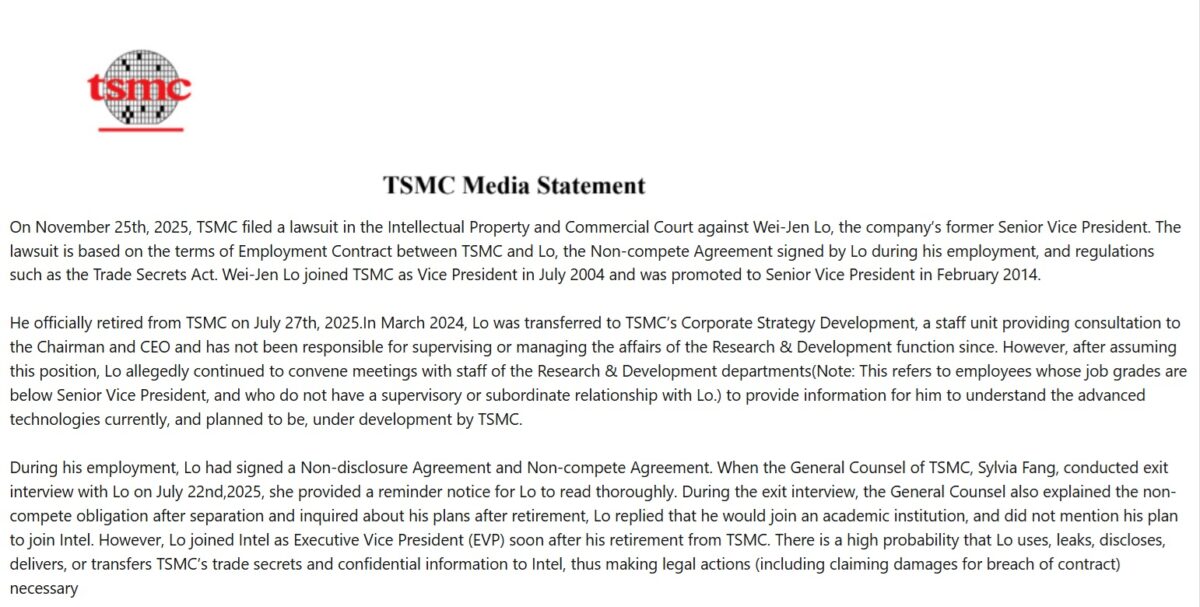
- Deception Allegations: Lo reportedly informed TSMC of his retirement, allowing him to take personal notes, which would not have been permitted if his move to a competitor was known.
- Direct Competition: Lo’s new role at Intel’s manufacturing and packaging business directly competes with TSMC’s core operations.
- Industry Impact: The lawsuit could significantly impact the delicate relationship between TSMC and Intel, two industry giants.
Launches
Q.ANT Raises Series A, Debuts Second-Gen TFLN Photonic Chip
Photonic chip startup Q.ANT has successfully closed a Series A funding round, bringing its total funding to $80 million, and announced a new four-year partnership with the Jülich Supercomputing Centre. The German company also unveiled its second-generation chip, the Q.ANT NPU 2, along with an updated software stack enabling training on its platform. This new chip focuses on energy-efficient AI acceleration for complex neural networks beyond LLM inference.

- Second-Gen NPU 2: Features increased performance (8 GOPS from 1 MOPS) and a higher clock speed (2 GHz from 200 MHz), with 8 individual channels for parallel operation.
- Thin-Film Lithium Niobate (TFLN) Process: Q.ANT’s chips leverage TFLN’s non-linear optical properties for natural acceleration of non-linear mathematics, leading to significant energy savings.
- Strategic Partnership: The collaboration with Jülich Supercomputing Centre will explore photonic computing applications and integration with classical computing, with servers shipping in H1 2026.
Charts
Creating a Thriving Chemical Semiconductor Supply Chain in America
The U.S. semiconductor market is projected to reach over $140 billion by 2030, more than doubling from $68 billion in 2024. This growth, largely driven by AI demand, is expected to triple the demand for associated chemicals and materials to approximately $13 billion by 2030. Despite significant investments in domestic fabrication capacity, the U.S. faces a meaningful supply gap for many materials, with about 60% of supply chains relying on imports by 2030, necessitating an estimated $9 billion in capital expenditures to close this gap.

- Market Growth: US semiconductor market is set to double by 2030, reaching over $140 billion, with chemical and material demand tripling to $13 billion.
- Supply Gap: Despite $450 billion in announced private investments in fabs, the US anticipates a significant import reliance for 60% of materials by 2030.
- Investment Needed: An estimated $9 billion in one-time capital expenditure is required to establish a robust domestic chemical supply chain, crucial for regional independence and supply chain resilience.
Research
Memristor Materials: Exploring Unusual Sources
Researchers are exploring unconventional sources for memristor materials, discovering that substances like shiitake mushrooms, honey, and even human blood can exhibit memristive properties. These organic memristors, while not always matching the performance of traditional inorganic counterparts, offer unique advantages such as radiation resistance (mushrooms), biodegradability (honey), and potential for biomedical applications (blood), opening new frontiers for niche electronic devices.

- Shiitake Mushrooms: Demonstrate memristor-like behavior with high radiation resistance, suitable for aerospace and medical applications.
- Honey-Based Memristors: Offer a biodegradable alternative to traditional electronics, switching resistance in nanoseconds, with potential for eco-friendly devices.
- Blood-Based Memristors: Early experiments suggest blood can act as a memristor, holding promise for healthcare applications to treat ion imbalances.
Insight
AI Plays Multiple Roles Within EDA
Artificial Intelligence, particularly Large Language Models (LLMs) and agentic AI, is increasingly integral to Electronic Design Automation (EDA), addressing growing complexity and multi-physics challenges in chip design. Experts discuss how AI is being integrated both within EDA tools to enhance algorithms and externally to drive tools and workflows, making design processes more efficient and accessible. This evolution requires new abstraction models and robust verification to ensure accuracy and trust in AI-generated designs.

- AI Integration: AI is enhancing EDA tools internally (solver-level coupling for performance) and externally (agentic AI driving tools like an engineer).
- Shifting Left: New AI-generated abstraction models are crucial for making informed decisions earlier in the design flow, though model creation and validation remain costly.
- Evolving Engineer Role: AI is expected to automate burdensome tasks, shifting human effort towards defining architectural specifications and orchestrating AI agents, transforming design capabilities.
Stay tuned for more essential updates and groundbreaking developments shaping the semiconductor industry!